Tuesday, October 9, 2012

Wolf Spiders!

I hate spiders!  I especially hate big, hairy ones!!  Wolf spiders come in a variety of sizes, but some are up to 2 inches in length.  They are also hairy and sometimes mistaken for tarantulas.   
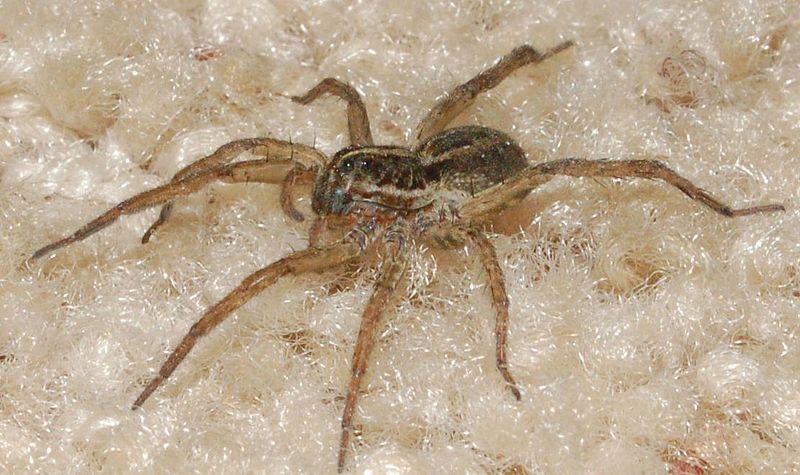
photo courtesy of wikipedia.org

Wolf spiders live mostly solitary lives.  They are hunters and have excellent eyesight.  Insects and other invertebrates make up their diet.  Their 8 eyes are arranged in 3 rows: the front row has 4 small eyes, the middle row has 2 large eyes, and the back row has 2 medium eyes.  The eyes reflect light, so they can be easily found at night with a flashlight.  Bites from wolf spiders are rare and they are not dangerous to humans.  Symptoms of a bite include swelling, itching, and mild pain. 

Outdoors, wolf spiders are found in a variety of habitats, but they are most common in grasslands, meadows, and fields.  They can also be found beneath stones or other items.  To help keep them away, limit the amount of ground-covering vegetation near your home.  Keep them outdoors by sealing up cracks and holes in the outside of the house.  Make sure there are tight-fitting screens on all attic and foundation vents.  Also, seal around all pipe lines.  

The largest species of wolf spider in the United States is the Carolina Wolf Spider.  It was named South Carolina's official state spider in 2000.  Below is a photo of a Carolina Wolf Spider found in a shed in Illinois.  
Photo courtesy of Daniel Macintyre; wikipedia.org

Wolf spiders do not build webs.  They hide under rocks or other objects when they are not hunting.  Some species even burrow into the soil.  The egg sacs of wolf spiders are attached to the spinnerets, or structures that produce silk, at the end of the abdomen.  After hatching, the young spiderlings continue to ride on their mother until partially grown.  

Mother with babies; photo courtesy of southcarolinaparks.com
 

Friday, October 5, 2012

Is Your Home Fallproof?


The weather is cooler, the leaves are starting to change colors, and my TV is always on football.  The signs of fall are all around.  Those summer time insects will soon be gone, and we can be pest free for awhile, right?  Not exactly!  As the weather gets cooler, many insects and rodents look for warmer places to spend the winter.  Your warm and cozy home can be very inviting.  Over the next few weeks, I will highlight some different pests that are common in the fall.  No matter the pest, however, here are some tips to help keep them out of your home this fall.
  • Inspect the perimeter of your home.
  • Seal as many holes and cracks on the outside of the house as possible.  This is especially important on the south and west sides where the sun heats the home. 
  • Seal up cracks around doors and windows.
  • Make sure there are tight fitting screens on all foundation and attic vents.
  • Remove any sources of standing water.
  • Trim tree limbs and bushes near your home.
  • Remove piles of leaves or debris.
  • Seal around pipes.
  • Clean regularly!  Wipe off couter tops and sweep daily to remove leftover food crumbs or spills. 
  • Store food in airtight containers.
  • Rinse out food containers and drink cans before disposing them.
  • Get rid of clutter.
  • Wipe down baseboards.
  • Properly clean clothing before storing for winter.
It's simple.  Do your best to prevent pests from entering by eliminating any points of entry.  Then, make the ones that got through want to leave by eliminating food and water sources indoors.  Whether you would like help preventing pests in the first place or you've already come across that problem pest, Mid-Georgia Pest Control would be happy to serve your needs.  Call today at (770)962-4240 to set up an inspection and learn about our pest prevention program.   

Monday, October 1, 2012

Army Worms!

Photo courtesy of extension.org
Fall has arrived, and this time of year is when army worms are most numerous.  These particular caterpillars are the larvae stage of a moth.  They mostly feed on grasses, like bermuda grass, and small grain crops.  Once they have exhausted one food supply, they move on to the next available food source.  Army worms move in large numbers, giving them the appearance of an "army."

Adult army worms are around 1-2 inches long.  They are dull yellow to light green to gray in color with stripes running down the length of the body.  There is an inverted "Y" shape on the head and 3 thin white stripes on the back just behind the head.

Army worms can cause a lot of damage to crops and grasses.  They mostly feed at night and hide during the day under vegetation or loose soil.  Some indicators that army worms have been feeding include leaf damage, worm frass (droppings) around the base of plants, or brown patches that resemble drought damage.

Photo courtesy of blogs.cornell.edu
 The adult moth is ash gray in color with a wingspan of around 1.5 inches.  Moths lay eggs in folds in leaves, grasses, or the underside of tree limbs.  The small, white, pearl-like eggs are laid in masses or rows.  After the larvae hatch and complete their feeding, they burrow into the soil to pupate into moths.


Photo courtesy of wikipedia.org
 

Thursday, September 27, 2012

Q & A With a Four Year Old: "How Do Ants Carry Stuff?"

Out of the blue, my four year old asked, "How do ants carry stuff?"  We've all seen the cartoons of ants carrying whole pieces of food on their back like this, right?


picture courtesy of Carla Haley; uaex.edu

We imagine an army of ants is going to walk across our picnic blanket, pick up our entire sandwich, and haul it back to it's nest carefully on it's back.  However, this isn't accurate at all.  In reality, ants use their mandibles, or jaws, to hold and carry things.  These same mandibles can be used for biting, cutting, digging, and fighting.  This would be a more accurate image:


photo courtesy of blog.wildaboutants.com

Unlike the average person, ants can carry 10-50 times their body weight.  It's not that ants have superpowers, it's that the proportion of their mass that is muscle is very high.  Ants' muscles are thicker relative to their body size than those of larger animals or humans.  This means they can produce more force pound for pound, or in an ant's case, milligram for milligram.

Here's a great photo of a leaf cutter ant carrying a leaf more than three times its size:


photo by Roy Toft; nationalgeographic.com


Friday, September 21, 2012

Caterpillar Webs!


I noticed these webs in a tree behind my kids' preschool and was very intrigued.  When we think of webs, we think spiders, but these are actually webs from caterpillars.  There are several kinds of caterpillars that create web-like nests in trees.  The most common in our area are the eastern tent caterpillar and fall webworm.  I believe the webs I observed are from the fall webworm.


Eastern tent caterpillars typically build their silken "nests" in the fork of branches and are seen in the spring and early summer.  Fall webworms, on the other hand, build their webs around the end of branches and are most common in August and September.  Sometimes multiple generations occur each year, in which case the earlier generation may be seen closer to June.


Fall webworms overwinter in cocoons as pupae beneath soil debris or just under the soil surface.  Once the larvae hatch and build their web nest, they remain within the web mass during development.  Once the leaves inside the web have been consumed, the caterpillars expand the web to enclose new foliage.  Webs of mature caterpillars may be 2-3 feet long.  Full grown caterpillars are only 1 to 1 1/4 inches long.  Multiple colonies can also be found in the same tree.  The nests shelter the caterpillars from rain and protect them from predators and parasites.  As their development comes to completion, they will leave the nest and seek shelter under plant debris or soil.  Here they will spin a loose cocoon in which they pupate.


There are two species of fall webworm: redheaded and blackheaded.  As the names suggest, one has a red head while the other has a black head.  Both are hairy and have a yellowish to gray body.  These caterpillars use a wide variety of host plants-almost any deciduous tree will do.  Some of the most common, however, are fruit trees, mulberry, hickory, walnut, and elm.


photo courtesy of hyg.ipm.illinois.edu
photo courtesy of G.Keith Douce, University of Georgia; caes.uga.edu


So, what do these caterpillars become?  They are moths and are mostly white in color, sometimes having black or brown spots on the forewings.  The spotted moths are more common in the South, while northern states often have only solid white moths.   


photos courtesy of Biodiversity & Ecosystem Risk Assessment; wikipedia.org

Monday, September 10, 2012

Rise in West Nile Virus Cases!

The cooler evenings make it inviting to hang out on the porch or play in the yard with the kids before bed.  That is, until you realize that you are being "eaten up" by those pesky mosquitoes.  We are not done with mosquitoes for this season, and according to the CDC, as of last week, cases of West Nile Virus are up 25% from the week before.  If this trend continues, this year could be the most severe outbreak on record in the United States.  West Nile Virus was first detected in the United States in 1999 in New York City.  The worst overall outbreak was in 2003 with 9,862 cases and 264 deaths.  So far, this year's outbreak is 3 times the size of last year's. 

As of September 4, 2012, there have been 1,993 cases reported, according to the CDC.  Of those, 87 resulted in death.  Reports have come from 48 states, with Alaska and Hawaii being the only states with no reports.  The majority of cases (about 70%) have come from 6 states: Texas, South Dakota, Mississippi, Oklahoma, Louisiana, and Michigan.  Texas has been hit the worst, accounting for about half of all reported cases.  They have reported over 1,000 cases with 40 deaths.  In Georgia, the CDC reports that we've had 16 neuroinvasive cases, 6 non-neuroinvasive cases, and 3 deaths.   

Of the almost 2,000 cases reported this year, 54% have been of the neuroinvasive form of West Nile Virus, which can lead to meningitis (inflammation of the tissue that surrounds the spinal cord and brain) and encephalitis (inflammation of the brain).  A milder form is more common and often not reported.  In fact, 80% of people infected with the virus will have no symptoms at all.  When symptoms are present, people may experience flu-like symptoms such as fever, headache, body aches, nausea, vomiting, swollen lymph glands, or a rash on the chest, stomach and back.  These symptoms generally last a few days to several weeks but pass on their own with no lasting effects.  However, 1 in 150 people infected with West Nile Virus will have the serious form of the virus.  Symptoms include high fever, headache, neck stiffness, disorientation, tremors, coma, muscle weakness, vision loss, numbness and paralysis.  Sometimes these effects may be permanent and even result in death.


photo courtesy of Jim Gathany/CDC; wikipedia.org
West Nile Virus is spread by mosquitoes that have been infected by feeding on infected birds.  The best way to prevent being infected is to prevent mosquito bites in the first place.  The peak biting times for mosquitoes are dawn, dusk, and early evening, so stay indoors during these times if possible.  Wear long sleeves and pants if you are outdoors, and use repellents according to the labels.  You can also decrease the number of mosquitoes by eliminating their breeding grounds.  Remove any standing water where mosquitoes can lay eggs.  For further protection, Mid-Georgia Pest Control offers mosquito treatments to help control the mosquito population in your yard.  For more information, call us today at (770)962-4240.          

Tuesday, September 4, 2012

Did You Say "Fly Larvae"?

Life got interesting around our house last week!  We have a cat that is both indoor and outdoor.  She came inside Monday morning, and I noticed a sore on her side.  She sometimes comes home with a scratch from a scuffle she's had during the night, but this didn't look quite right to me.  Had I known what it was, I would have taken a picture.  I found this picture, though, that looks very similar:

photo courtesy of Anderson County Animal Hospital; www.animalhospitaltn.com

I took her to our vet and left her there for them to clean up the area and take a closer look.  When they looked closer, they saw something coming up out of the hole.  I got a phone call that our cat had a "wolf", or fly larvae.  Did I hear that right?  Fly larvae in my cat?

This isn't your everyday house fly.  It is from the genius Cuterebra, a bee-like species, known as a botfly.  They deposit eggs around the openings of animal burrows or on blades of grass.  Animals become infested as they pass through contaminated areas.  Common animals that are infested are rabbits, squirrels, mice, rats, chipmunks, cats, and dogs.  The heat from the host animal causes the eggs to hatch.  The larvae (yes, small maggots!) enter the host through the mouth or nose when the animal is grooming or through an open wound already present on the animal.  Then they move to various subcutaneous locations where they create a small lump in the skin called a "warble."  They make a breathing pore in the warble to get air.  If left alone, the larvae will stay about a month then fall to the ground where they pupate into flies.

In some cases, the full cycle could happen with no harm done to the host animal.  However, some animals will have symptoms caused by the unwanted hitchhiker.  These include:
  • respiratory signs: cough, fever, shortness of breath
  • neurological signs: dizziness, circling, paralysis, blindness
  • opthalmic (eye) lesions: caused by larvae in the eye
  • warbles: you might actually see the maggots under the skin
Summer and fall are the most common times to see these lesions.  They are also typically around the head, neck, and trunk.  Do not squeeze the lesion because this may rupture the larvae and lead to further infection.  See your vet for proper care and removal.

So, what happened with our cat?  The vet removed the larvae and cleaned up the infected area.  She's taking some medicine and doing great.  Here's a picture of what she looked like after the removal of her "wolf":


I've got to admit, when I heard what was causing the spot on my cat, I had two reactions.  The cat owner in me was completely horrified.  How could something so disgusting and nasty happen to my baby.  Bugs of any kind have always grossed me out and scared me.  It doesn't get much nastier than something living inside the animal you love so much.  However, the bug blogger in me was very intrigued, especially when I knew that my cat was going to be fine.  I couldn't wait to research this and learn more.  I do hope, however, that I never see a warble again!