

Showing posts with label spiders. Show all posts
Showing posts with label spiders. Show all posts
Friday, September 12, 2014


Friday, February 21, 2014
Marbled Orb-Weaver Spider
Sometimes you come across those creatures that fascinate and intrigue you. Here's a cool spider one of our technicians found.
Read about it on our website: http://www.midgapestcontrol.com/marbled-orb-weaver-spider/.

Friday, January 17, 2014
Spanish Moss Jumping Spiders!
Drapes of Spanish moss hanging from the trees is pure Southern beauty to me. Did you know there's a spider named after Spanish moss? Check it out on our website at http://www.midgapestcontrol.com/spanish-moss-jumping-spiders/.

Wednesday, November 28, 2012
Holiday Hitchhikers in your Christmas Tree
Thanksgiving is behind us and the leftovers are finally gone. The signs of the Christmas season are all around. For many of us, that means time to put up the Christmas tree. One of my all time favorite movies is "National Lampoon's Christmas Vacation." After getting the tree up, the Griswolds find an unwanted guest: a squirrel. Chances are you would notice something like that before bringing your tree inside, but there are some less noticeable pests that might be hiding in your tree.
Although problems are rare, bringing in a real Christmas tree can also bring in extra guests for the holidays. Most of the pests that are sometimes found are not a threat to you or your home. If fact, they will most likely stay unseen on the tree or die because of lack of appropriate food, warm temperatures, and low humidity. However, the warmth of the indoors can sometimes increase their activity. Some common pests found are aphids, mites, scale insects, adelgids, bark beetles, spiders, and praying mantid eggs.
To help prevent any holiday hitchhikers, thoroughly inspect your tree for signs of any of the pests mentioned above. Small holes in the trunk with sawdust trails are a sign of bark beetles. Vigorously shake the tree before bringing it inside. This will help to remove many insects. Check for bird nests as they may contain bird parasites such as mites and lice. Egg masses of praying mantids are sometimes found. Remove the twig with the mass on it and place it in an evergreen tree or shrub outdoors. The warmth of your home may cause the eggs to hatch. Vacuum up any pests that become active and leave the tree. Do NOT use aerosol insect sprays. They are flammable and should not be sprayed on the Christmas tree.
Although problems are rare, bringing in a real Christmas tree can also bring in extra guests for the holidays. Most of the pests that are sometimes found are not a threat to you or your home. If fact, they will most likely stay unseen on the tree or die because of lack of appropriate food, warm temperatures, and low humidity. However, the warmth of the indoors can sometimes increase their activity. Some common pests found are aphids, mites, scale insects, adelgids, bark beetles, spiders, and praying mantid eggs.
 |
| Cinara aphids; photo courtesy of ncsu.edu |
 |
| Praying mantid egg case; photo courtesy of ncsu.edu |
Tuesday, October 9, 2012
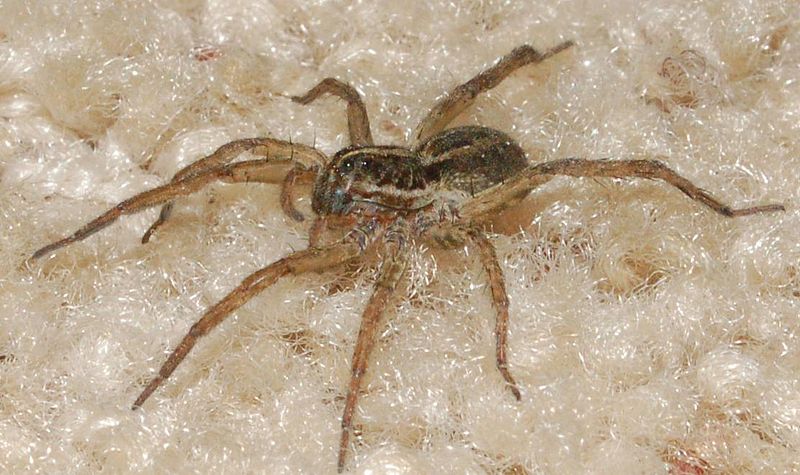
Wolf Spiders!
I hate spiders! I especially hate big, hairy ones!! Wolf spiders
come in a variety of sizes, but some are up to 2 inches in length. They
are also hairy and sometimes mistaken for tarantulas.
 |
| photo courtesy of wikipedia.org |
Wolf spiders live mostly solitary lives. They are hunters and have excellent eyesight. Insects and other invertebrates make up their diet. Their 8 eyes are arranged in 3 rows: the front row has 4 small eyes, the middle row has 2 large eyes, and the back row has 2 medium eyes. The eyes reflect light, so they can be easily found at night with a flashlight. Bites from wolf spiders are rare and they are not dangerous to humans. Symptoms of a bite include swelling, itching, and mild pain.
Outdoors, wolf spiders are found in a variety of habitats, but they are most common in grasslands, meadows, and fields. They can also be found beneath stones or other items. To help keep them away, limit the amount of ground-covering vegetation near your home. Keep them outdoors by sealing up cracks and holes in the outside of the house. Make sure there are tight-fitting screens on all attic and foundation vents. Also, seal around all pipe lines.
The largest species of wolf spider in the United States is the Carolina Wolf Spider. It was named South Carolina's official state spider in 2000. Below is a photo of a Carolina Wolf Spider found in a shed in Illinois.
 |
| Photo courtesy of Daniel Macintyre; wikipedia.org |
Wolf spiders do not build webs. They hide under rocks or other objects when they are not hunting. Some species even burrow into the soil. The egg sacs of wolf spiders are attached to the spinnerets, or structures that produce silk, at the end of the abdomen. After hatching, the young spiderlings continue to ride on their mother until partially grown.
 |
| Mother with babies; photo courtesy of southcarolinaparks.com |
Tuesday, August 28, 2012
A Battle with Brown Recluse Spiders!
A family in Missouri is at war with brown recluse spiders. It's scary enough if you find one of these spiders around your home. The Bockhorn family has found hundreds! According to a report from Fox 4 News in Kansas City, Jessica Bockhorn and her children fled their home after she was bitten by a brown recluse spider. Darren Bockhorn is still battling the creatures that have infested his home. He says the home was empty for a year before his family moved in. Apparently, these brown recluse spiders took advantage of this and made the home their own.
Brown recluse spiders are native to the United States in the Midwestern and Southeastern states. They are also know as fiddle-back or violin spiders because of the violin shape marking on their back (see above). The most common places to find a brown recluse is in woodpiles, sheds, closets, garages, and basements. Inside encounters often occur in shoes, bed sheets of infrequently used beds, clothes left lying on the floor, and inside work gloves. The spider is not aggressive, and bites typically occur when a brown recluse is trapped against the skin, such as when the person is putting on clothes the spider is inside of.
Of all the spiders that you may encounter in the United States, only a few are considered poisonous. The Brown Recluse is one of them. Most bites actually result in a mild lesion that heals on its own. Bites may even go unnoticed initially because it is painless when it occurs. Symptoms will typically develop within the two to eight hours following the bite. Some symptoms include itching, nausea, vomiting, fever, and muscle/joint pain. In some cases, the bite becomes necrotic, destroying soft tissue. Although most of these lesions heal without complication, it can sometimes take months to heal and may leave a permanent scar. In extreme cases, the bite can become systemic, resulting in organ damage and even death. Those most susceptible to systemic reactions are children, elderly, and debilitatingly ill individuals.
To help prevent being bitten by a brown recluse spider:
Our thoughts go out to the Bockhorn family and the nightmare they are in.
 | ||
| photo courtesy of the Public Health Image Library; www.cdc.gov |
Of all the spiders that you may encounter in the United States, only a few are considered poisonous. The Brown Recluse is one of them. Most bites actually result in a mild lesion that heals on its own. Bites may even go unnoticed initially because it is painless when it occurs. Symptoms will typically develop within the two to eight hours following the bite. Some symptoms include itching, nausea, vomiting, fever, and muscle/joint pain. In some cases, the bite becomes necrotic, destroying soft tissue. Although most of these lesions heal without complication, it can sometimes take months to heal and may leave a permanent scar. In extreme cases, the bite can become systemic, resulting in organ damage and even death. Those most susceptible to systemic reactions are children, elderly, and debilitatingly ill individuals.
To help prevent being bitten by a brown recluse spider:
- Perform routine, thorough house cleaning.
- Reduce clutter in garages, basements, and attics.
- Move all firewood, building material, and debris away from the foundation of the home.
- Clean behind outside home shutters.
Our thoughts go out to the Bockhorn family and the nightmare they are in.
Subscribe to:
Posts (Atom)