Life got interesting around our house last week! We have a cat that is both indoor and outdoor. She came inside Monday morning, and I noticed a sore on her side. She sometimes comes home with a scratch from a scuffle she's had during the night, but this didn't look quite right to me. Had I known what it was, I would have taken a picture. I found this picture, though, that looks very similar:
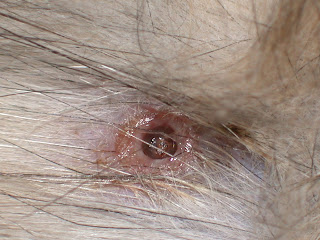 |
| photo courtesy of Anderson County Animal Hospital; www.animalhospitaltn.com |
|
|
I took her to our vet and left her there for them to clean up the area and take a closer look. When they looked closer, they saw something coming up out of the hole. I got a phone call that our cat had a "wolf", or fly larvae. Did I hear that right? Fly larvae in my cat?
This isn't your everyday house fly. It is from the genius Cuterebra, a bee-like species, known as a botfly. They deposit eggs around the openings of animal burrows or on blades of grass. Animals become infested as they pass through contaminated areas. Common animals that are infested are rabbits, squirrels, mice, rats, chipmunks, cats, and dogs. The heat from the host animal causes the eggs to hatch. The larvae (yes, small maggots!) enter the host through the mouth or nose when the animal is grooming or through an open wound already present on the animal. Then they move to various subcutaneous locations where they create a small lump in the skin called a "warble." They make a breathing pore in the warble to get air. If left alone, the larvae will stay about a month then fall to the ground where they pupate into flies.
In some cases, the full cycle could happen with no harm done to the host animal. However, some animals will have symptoms caused by the unwanted hitchhiker. These include:
- respiratory signs: cough, fever, shortness of breath
- neurological signs: dizziness, circling, paralysis, blindness
- opthalmic (eye) lesions: caused by larvae in the eye
- warbles: you might actually see the maggots under the skin
Summer and fall are the most common times to see these lesions. They are also typically around the head, neck, and trunk. Do not squeeze the lesion because this may rupture the larvae and lead to further infection. See your vet for proper care and removal.
So, what happened with our cat? The vet removed the larvae and cleaned up the infected area. She's taking some medicine and doing great. Here's a picture of what she looked like after the removal of her "wolf":
I've got to admit, when I heard what was causing the spot on my cat, I had two reactions. The cat owner in me was completely horrified. How could something so disgusting and nasty happen to my baby. Bugs of any kind have always grossed me out and scared me. It doesn't get much nastier than something living inside the animal you love so much. However, the bug blogger in me was very intrigued, especially when I knew that my cat was going to be fine. I couldn't wait to research this and learn more. I do hope, however, that I never see a warble again!


